There’s been a clear shift in the way consumers pay for products and services in the UK. Ownership is no longer the focus. Flexibility is.
From streaming platforms to smartphones, gym memberships to cosmetic treatments, customers are becoming increasingly comfortable with spreading the cost through monthly payments rather than paying everything upfront.
What started with entertainment subscriptions has now influenced almost every sector. Consumers are being conditioned to think in monthly affordability rather than total price.
For businesses selling expensive products or services, that shift matters.
Consumers are prioritising affordability over upfront cost
Over the last few years, rising living costs and tighter household budgets have changed spending habits across the UK. Customers still want quality products and services, but they are far more conscious about cash flow.
Instead of asking:
“How much does it cost?”
People are now asking:
“How much is it per month?”
That change in mindset is one of the biggest reasons Buy Now Pay Later and monthly finance options have exploded in popularity.
According to Finder research, 45% of Brits used BNPL services in 2025, while more than half of UK adults have now used some form of Buy Now Pay Later product. (finder.com)
UK Finance also reported that BNPL now accounts for around 8% of all online and physical point-of-sale payments in the UK. (ukfinance.org.uk)
This is no longer a niche payment method. It’s becoming part of everyday consumer behaviour.
How Covid changed the way consumers spend
The pandemic accelerated a major shift in consumer behaviour across the UK.
During Covid, households became far more focused on managing monthly budgets, preserving cash flow and avoiding large upfront spending. At the same time, online shopping and digital subscriptions became part of everyday life.
That shift didn’t disappear once restrictions ended.
Instead, consumers became increasingly comfortable with spreading costs through instalments and monthly payments. What was once mainly associated with finance agreements or credit cards became normalised across almost every part of daily spending.
Research from UK Finance shows Buy Now Pay Later usage grew significantly following the pandemic, with 25% of UK adults using BNPL in 2024 compared to 14% in 2023. (ukfinance.org.uk)
The cost of living crisis also played a major role. Forbes Advisor found that 70% of BNPL users said they were using these services more frequently as a direct result of rising living costs. (forbes.com)
Consumers today are more financially cautious than ever. Even higher earners are increasingly choosing monthly affordability over a large one time purchases, not necessarily because they can’t afford the upfront cost, but because flexible payments fit more comfortably into modern budgeting habits.
This is one of the biggest reasons monthly finance options have become so important for businesses selling premium products and services.
Monthly payments are now normalised
One of the biggest drivers behind this shift is subscription culture.
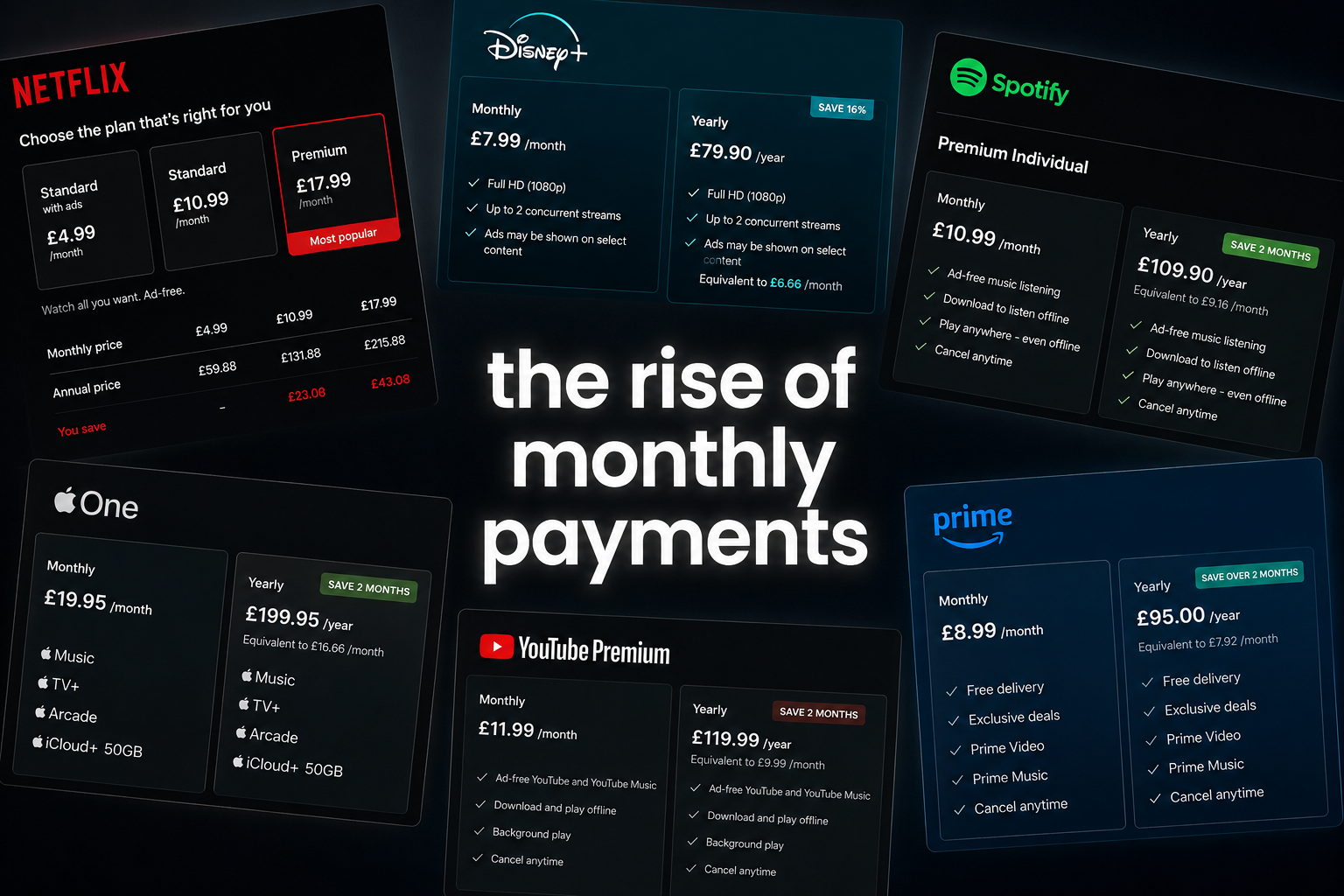
Consumers are already paying monthly for:
- Netflix
- Disney+
- Spotify
- Apple One
- Amazon Prime
- YouTube Premium
- Adobe
- Microsoft 365
These brands have helped train consumers to view monthly payments as the standard way to access products and services.
What’s interesting is how these companies market pricing. The monthly figure is always front and centre. The yearly price is usually shown as the saving.
Streaming giants rarely lead with ‘£119.99 per year.’ Instead, they lead with ‘Just £9.99 a month.’
That positioning matters because consumers naturally process smaller monthly figures as more manageable and less risky.
The psychology is simple. A £3,000 purchase feels expensive. £79 per month feels achievable.
That same behaviour is now influencing how consumers browse for major purchases across industries.
This trend goes far beyond retail
When people hear Buy Now Pay Later, they often think of Klarna and online shopping baskets.
But the shift toward monthly affordability is much bigger than retail fashion purchases.
Consumers are increasingly looking for finance options across sectors such as:
- Home improvements
- Dental treatments
- Cosmetic procedures
- Solar and renewable energy
- Furniture
- Education and training
- Automotive services
- Weddings and events
For many businesses, offering finance is no longer a bonus, It’s becoming an expectation.
If customers can spread the cost elsewhere, they’ll expect the same flexibility from your business too.
Why offering monthly payments increases conversions
The businesses adapting quickest to this shift are seeing clear advantages.
Higher conversion rates
Customers are more likely to proceed when the upfront cost barrier is reduced.
Increased average order values
When affordability improves, customers often choose higher specification products or additional services.
More accessible pricing
Monthly payments open your offering up to a wider audience without forcing you to discount.
Competitive advantage
Businesses that offer finance can stand out against competitors still relying on upfront payments only.
Consumers increasingly compare businesses not just on product quality, but on payment flexibility.
The businesses winning attention are the ones leading with affordability
The smartest brands today don’t hide finance options deep in checkout pages.
They lead with them.
Consumers now expect to see: “From £49 per month” before they even enquire. This mirrors exactly what subscription brands have done successfully for years. Monthly pricing has become a powerful marketing tool because it reframes affordability.
Rather than making customers focus on a large payment, it helps them see how the purchase fits into their monthly budget.
What this means for UK businesses
Consumer expectations have changed quickly.
Monthly payments are no longer associated purely with credit or borrowing. For many customers, they simply represent convenience and flexibility.
That creates a major opportunity for businesses selling premium products or services.
Offering finance can help remove hesitation at the point of purchase and make premium products feel more accessible without reducing margins.
For sectors where upfront costs can delay decisions, flexible payment options can be the difference between a lost lead and a completed sale.
How Ideal4Finance helps businesses offer monthly payments
At Ideal4Finance, the focus is helping businesses give customers access to manageable monthly payment options for significant purchases.
Rather than competing with smaller duration retail BNPL providers, Ideal4Finance supports businesses that sell meaningful products and services where finance can genuinely improve accessibility for customers.
Whether it’s home improvements, healthcare, renewable energy, or specialist services, offering finance can help businesses increase enquiries, improve conversions and give customers more flexibility in how they pay.
As consumer behaviour continues shifting toward monthly affordability, businesses that adapt early will be in the strongest position.
The question is no longer whether customers want flexible payments.
It’s whether businesses are ready to offer them.